BLOG
There is something that happens when you walk into a room full of people who already understand.
No explanations needed. No halting attempts to describe what frontotemporal degeneration is, why it matters, and the profound impact it has on people’s lives, those diagnosed and their loved ones. In this room, everyone already knows. And in that shared knowing, something extraordinary takes place.
Last week, I had the privilege of attending the Association for Frontotemporal Degeneration's Annual Education Conference. I come to this event as the Program Manager for the Progranulin Information Navigator, a sponsored genetic testing program and clinical trial director for individuals and families affected by GRN-related FTD. Regardless of my professional role, what I carry home from this conference is always something more personal — a renewed understanding of why community, in all its layered forms, is such an important part of the FTD journey.
The AFTD Education Conference has been bringing together caregivers, people living with FTD, researchers, and clinicians for over a decade. Year after year, the agenda reflects what the FTD community needs most: honest, accessible information about a disease that is still profoundly misunderstood, and a space to ask the questions that linger after clinic appointments end.
This year was no different. Sessions covered everything from the science of neurodegeneration to navigating daily caregiving challenges, from clinical trial updates to the emotional terrain of a diagnosis that can take years — and several wrong turns — to reach. The information matters enormously. For a disease as clinically diverse and frequently misdiagnosed as FTD, being in a room where experts speak plainly and families are treated as partners in understanding is a gift. The conference is not a lecture. It is a conversation, and the room is richer for everyone in it.
FTD is rare but it is also the most common form of dementia for people under 60. It is a condition that remains widely unknown, frequently confused with psychiatric illness, and is chronically underfunded relative to its impact. Despite that, one of the most significant gifts of the AFTD conference is simply being reminded that you are not alone in this unfamiliar territory.
The broader FTD community is a community built by necessity. It formed because families who received a diagnosis found almost no one who understood what they were facing. They found each other. Over time, they built the infrastructure of support and advocacy that now exists through the AFTD.
There is a particular kind of solidarity in rare disease communities. When your disease is uncommon enough that your own neighbors, doctors, and sometimes even neurologists have never heard of it, finding a community of people who have lived it — who can finish your sentences and validate your experience — is not a small thing. It is, for many families, the thing that makes the rest bearable.
Within the larger FTD community, there are smaller ones, and they hold a particular power.
For families facing a hereditary form of FTD — those living with or at risk for mutations in genes like GRN (progranulin), C9orf72, or MAPT — the experience of FTD carries a weight that is uniquely its own. These families don't just grieve a diagnosis; they navigate the knowledge — or the uncertainty — that the disease may run through generations. Roughly 15–20% of FTD cases have an identifiable genetic cause, and these mutations are inherited in an autosomal dominant pattern, meaning each child or sibling of an affected person faces a 50% chance of carrying the same variant.
That fact that shapes decisions about whether to have children, whether to pursue presymptomatic genetic testing, whether to enroll in clinical trials that require a genetic diagnosis. It shapes relationships within families, sometimes in beautiful ways — and sometimes in painful ones.
At the conference, I find myself most moved by the moments when at-risk individuals — people who may carry a gene variant but have no symptoms yet — find each other. The recognition on their faces is different from other kinds. They are managing a kind of anticipatory grief alongside ordinary life, and they do it largely in private, because the world doesn't quite have a script for "I might develop a FTD in 15 years." These are communities of the presymptomatic, the wondering, the not-yet-but-maybe. Their need for connection and information is urgent and specific, and it matters profoundly to the work we do at the Progranulin Information Navigator.
The GRN community — families whose FTD is caused by a variant in the progranulin gene — is a smaller circle still, with its own particular landscape. Progranulin-related FTD has been a focal point for therapeutic development precisely because a defined genetic cause offers a clear target: progranulin levels are low, so restoring them is the goal. Clinical trials are active. Gene therapy approaches are being tested. The science is moving. For families in this community, the conference offers something especially precious: a sense of hope for the future.
I return from every AFTD Education Conference reminded of the determination and hope of this community; a reminder that behind every referral and every eligibility check is a person who has probably spent months or years looking for answers, who may be navigating a family history that extends far beyond their own diagnosis, who needs not just a test result but a community of people who can help them understand what it means.
The Progranulin Information Navigator exists to improve access to genetic counseling and testing for those who are exploring a genetic cause for the FTD affecting them or their loved ones — at no cost to them — and to connect them with the clinical trials that represent real hope. But more than a program, it is a point of entry into a community. The community of people who understand what having a genetic form of FTD means. The community of families who have been here before and are willing to hold the door open.
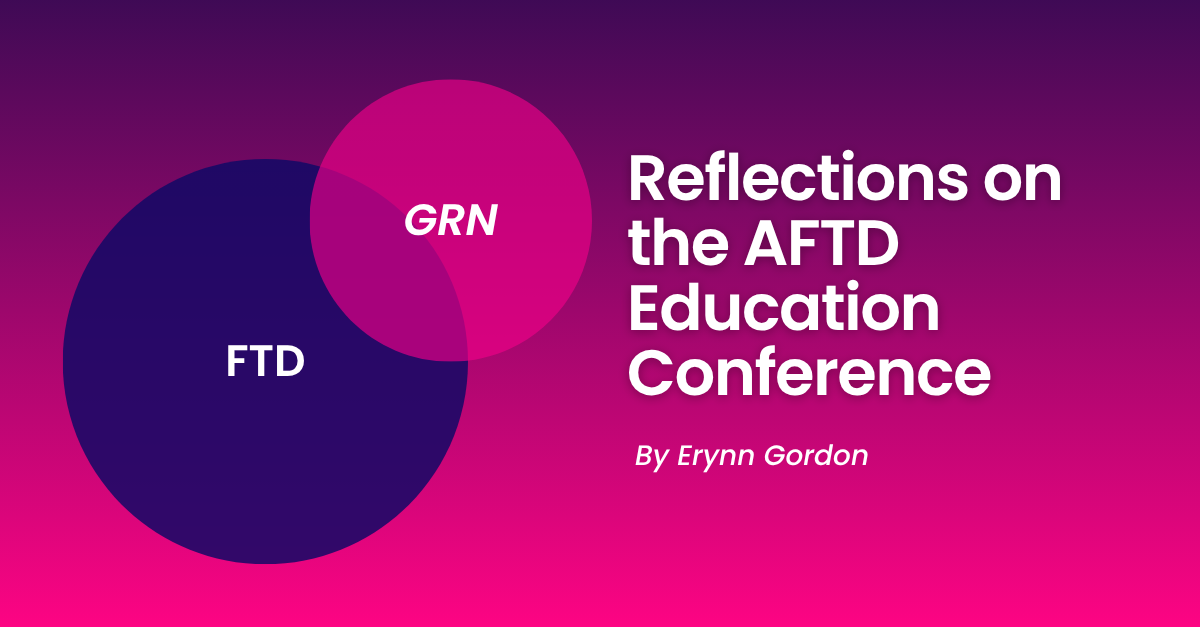
The AFTD Education Conference is one of the places where that community comes alive in the same room. Where the large and the small circles overlap. Where researchers and caregivers and presymptomatic individuals and people living with FTD and the people who work in service of them all look around and find that they are all working towards something together.
NOTE: The Site is provided for informational purposes only, and is not intended to provide, or be a substitute for, medical advice, diagnosis or treatment recommendations. Any user that intends to use information from the Site should first consult with their healthcare provider.


