BLOG
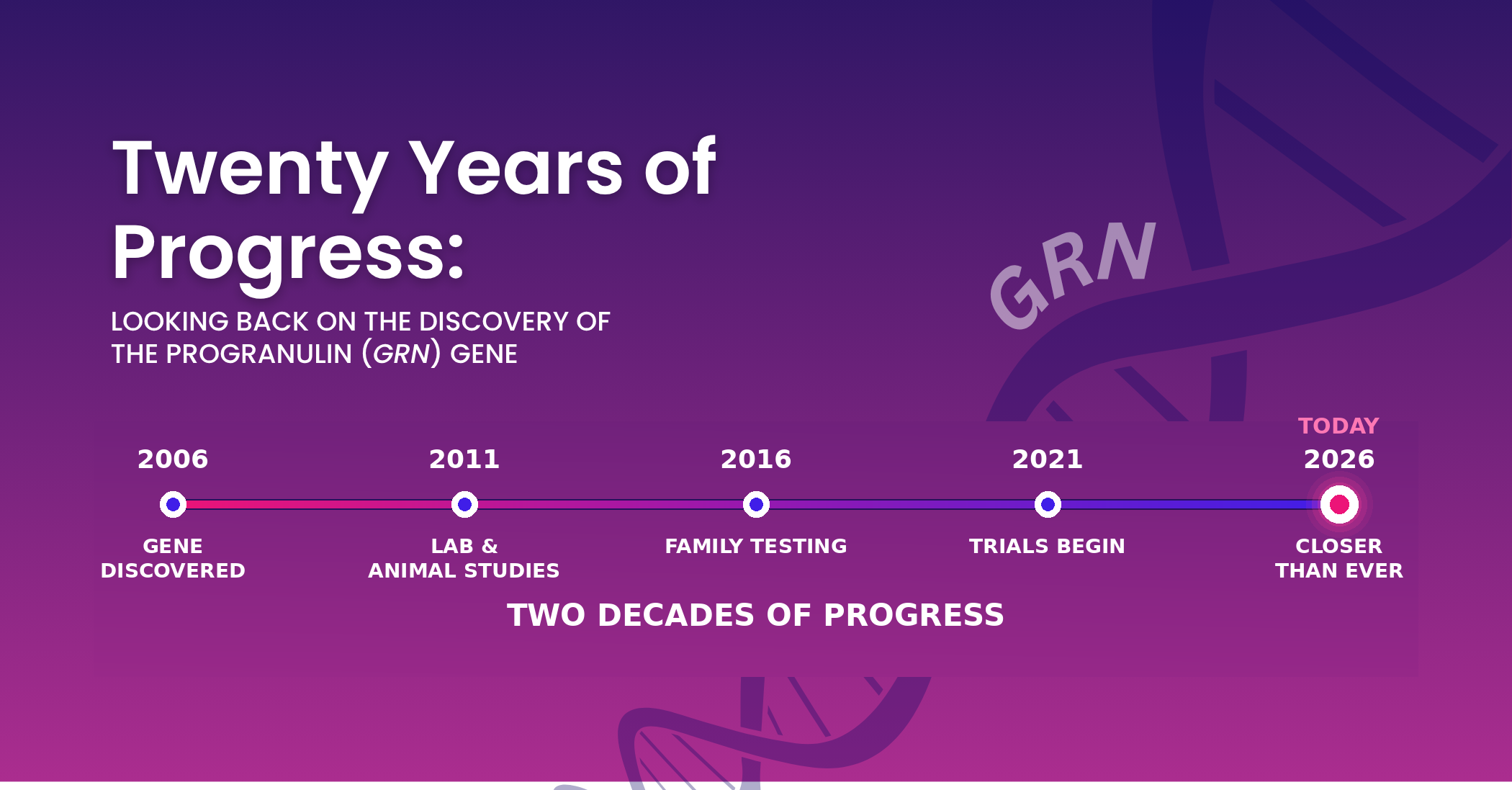
Twenty years ago, scientists made a discovery that would forever change what we know about frontotemporal dementia (FTD). In 2006, researchers found that changes in the progranulin gene, known as GRN, cause FTD. It was a breakthrough moment, not just for science, but for the many families who had been searching for answers.
This anniversary, and the incredible progress made over the last twenty years, is worth commemorating with a review of where we started and where we are now.
For families living with FTD before 2006, the experience was often isolating and confusing. Doctors could see that something was wrong in the brain, but they didn't always know why. This frustration was magnified for individuals who came from families where multiple people across generations were affected. Family members could see the pattern, and knew they were at risk themselves, but they didn’t know what was causing it and couldn’t access testing to better understand their personal risk.
Before 2006, only one gene, MAPT, had been linked to inherited FTD. The discovery of the progranulin gene opened the door to a much deeper understanding of the disease.
Think of your genes as instruction manuals for your body. The GRN gene contains the instructions for making a protein called progranulin, which plays an important role in keeping brain cells healthy by regulating inflammation, helping cells remove waste and helping the brain respond to injury.
GRN variants account for approximately 20–25% of familial FTD cases and about 10% of total FTD cases.1 That means a significant portion of all inherited FTD can now be traced back to this single gene.
Once researchers identified the GRN gene, families who had watched multiple generations struggle with FTD could now get genetic testing to find out if GRN was the cause of FTD in their family. While scary, for some families, genetic testing provided a way to obtain a measure of clarity after years of uncertainty.
Genetic testing also opened new doors for family planning and early monitoring. A person who knows they carry a GRN variant can work with their medical team to watch for early signs of the disease, participate in research studies, and make informed decisions about their future. Since the discovery in 2006, over 1000 individuals, with 130 different disease-causing variants in the GRN gene, have participated in research, helping researchers and doctors better understand progranulin-related FTD.2
The 2006 discovery didn't just help with diagnosis, it gave scientists a clear target for developing treatments. If the problem is too little progranulin, then the goal becomes finding ways to raise progranulin levels in the brain. That simple but powerful idea has guided nearly two decades of research.
Over the years, researchers developed laboratory models and animal studies to better understand what happens when progranulin is missing. Those early studies sparked great interest in developing ways to study progranulin deficiency and understand its consequences for the brain. Each study built on the last, slowly creating the foundation for the clinical trials we see today.
Twenty years later, the science has advanced rapidly in ways that would have seemed remarkable in 2006. Drug developers are now pursuing varied treatment approaches, including adding a healthy progranulin gene through gene therapy and replacing the missing progranulin protein directly.
Several clinical trials, including PROCLAIM, ASPIRE-FTD, and upliFT-D, have shown that gene therapy approaches are safe and effective at restoring progranulin levels in the brain. Elevation of progranulin protein (DNL593), is actively being tested in research participants with FTD; and there is also promising work on an oral treatment, VES001, designed to prevent the body from breaking down progranulin too quickly. While none of these experimental treatments are FDA approved yet, the development of multiple experimental therapies targeting GRN-FTD, just 20 years after the gene was discovered, is truly remarkable.
The research that led to the 2006 discovery of GRN would not have been possible without the families who participated in studies, donated to research, and shared their stories. Every clinical trial happening today stands on the shoulders of those early contributions.
And yet, there is still work to do. We don't have an approved treatment for GRN-FTD, but we are closer than we have ever been, and the pace of progress over the last twenty years gives real reason for hope.
To learn more about progranulin-related FTD, genetic testing, and the clinical trials that may be available to you or your loved one, visit our website and explore our educational resources. You don't have to navigate this alone.
NOTE: This blog post is for educational purposes only and does not constitute medical advice. Always consult with your healthcare provider before making decisions about research participation.


